4.2.1.1
Sharing agreement: Negotiation - Negotiating sharing agreement
Test: Test completeness: Two connectors can negotiate a data sharing agreement that supports a defined minimal state machine (the definition of the minimal state machine must be agreed beforehand).
The description of Test 4.2.1.1 was extracted from this page in the GitHub repository.
This file was last modified at 2026-06-24 15:37:50 UTC.
Information
-
Phase 1
-
Minimal? Yes
-
Related KPIs:
- Interoperability: The system provides components that negotiate a data sharing agreement through a common protocol. The data sharing protocol implements requests, responses, and states that produce an iterative data sharing negotiation which is semantically interpretable by an observer.
-
Evaluation Criteria:
The test assigns a numeric score based on the assessment, using the Functional Suitability metric from iso27001_kpis_subkpis.xlsx.
| Criteria | Scoring |
|---|---|
| No Coverage: The solution fails to implement any negotiation flow for the data sharing agreement based on the defined minimal state machine. | 0 |
| Minimal Coverage: The solution meets up to 25% of the technical requirements. This might include only a basic framework for the negotiation flow, with a significant part of the defined minimal state machine not implemented. | 1 |
| Partial Coverage: The solution satisfies approximately 50% of the technical requirements. This could involve a partially implemented negotiation flow for the data sharing agreement based on the defined minimal state machine, with several key elements missing or incomplete. | 2 |
| Significant Coverage: The solution covers about 80% of the technical requirements. This includes a well-implemented negotiation flow for the data sharing agreement based on the defined minimal state machine, with only minor elements or details that may still need refinement. | 3 |
| Full Coverage: The solution fully meets all technical requirements. This includes a fully implemented negotiation flow for the data sharing agreement based on the defined minimal state machine, with all elements thoroughly addressed and tested. | 4 |
Results
- Fiware
- protoEMDS Final Stack (EDC-based)
- EDC+VC
The results for Test 4.2.1.1 for Fiware were extracted from this page in the GitHub repository.
This file was last modified at 2026-06-24 15:37:50 UTC.
Environment
The test environment Fiware v0.2 was used as described in Fiware Deployment v0.2
Tested quality metric and method
The quality metric for this test is based on the criteria outlined in iso27001_kpis_subkpis.xlsx. In Phase 1, the focus is on the Functional Suitability metric. For detailed information, please refer to the Comparative criteria (checklists, ...) section in the test description.
Expected output
The test aims to assess the state machine implementation of the EDC ecosystem regarding the sharing negotiation.
Results
Assessment
According to TMF622 Product Ordering Management API User Guide a product order can be in the states:
- Acknowledged
- Rejected
- Pending
- InProgress
- Held
- AssessingCancellation
- PendingCancellation
- Cancelled
- Completed
- Failed
- Partial
Measured results
The current example only deals with placing the order with a request sent by the customer:
curl -v -X POST "${tmf_api_complete_url}/tmf-api/productOrderingManagement/v4/productOrder" \
   -H 'Accept: */*' \
   -H 'Content-Type: application/json' \
   -H "Authorization: Bearer ${SERVICE_ACCESS_TOKEN}" \
   -d "{
       \"productOrderItem\": [
         {
           \"id\": \"random-order-id\",
           \"action\": \"add\",
           \"productOffering\": {
             \"id\" :  \"${OFFER_ID}\"
           }
         }
       ],
       \"relatedParty\": [
         {
           \"id\": \"${FANCY_MARKETPLACE_ID}\"
         }
       ]}"
Therefore, it is unclear how the transition of states is handled. Especially:
- How a state change is triggered?
- By whom a state change is triggered?
- What effect does a state change or the state of an order item in general have to other components in the ecosystem?
There are no components that negotiate a state as mentioned in the test description.
In the current implementation of the FIWARE Connector and its components, the negotiation state is only minimally covered by having an entity that holds the state.
Functional suitability quality metric: 1
Notes
To consume an ordered product, a provider has to provide access to the consumer to that product. This is done by issuing a VC to the consumer that is accepted by the Policy Decision Point (PDP) of the provider and registering the issuer of the VC in the Trusted Issuer Registry (TIR) that is used by the providers' VCVerifier. In the current setup, there seems to be no relation between the state of a product ordering and the act of enabling access to a resource as described before.
The results for Test 4.2.1.1 for protoEMDS Final Stack (EDC-based) were extracted from this page in the GitHub repository.
This file was last modified at 2026-06-24 15:37:50 UTC.
Environment
This section identifies the technical context in which the protoEMDS Final Stack assessment is performed.
| Field | Value |
|---|---|
| Assessment context | Integration phase assessment of the EMDS final technical infrastructure |
| Result perspective | protoemds_final_stack |
| Stack under assessment | protoEMDS Final Stack (EDC-based) |
| KPI1 area | Sharing agreement |
| Existing test ID | 4.2.1.1 |
| Level | Technical |
| ISO/IEC 25010 mapping | Functional suitability, Compatibility, Security |
| Owner (tentative) | Xavier (Eurocat) |
| Reviewer | TBD |
| Deployment model assessed | TBD |
| Target environment | TBD |
| EDC version / release | TBD |
| Connector deployment reference | TBD |
| Assessment evidence | TBD |
The assessment should be completed using the deployment model for which evidence is realistically available. It is not mandatory to execute the same test in both CaaS and on-premise environments.
If only one deployment model is assessed, the other one should be marked as Not assessed.
Tested quality metric and method
This result reuses the existing stack-agnostic test definition in test.md and adds an protoEMDS Final Stack integration-assessment perspective.
It does not replace the historical stack-specific result files, such as result_edc_vc.md or result_fiware.md.
The quality metric, expected output and comparative criteria remain those defined by the original test. This result file should only capture the evidence and assessment outcome for the selected protoEMDS Final Stack deployment.
Test-specific assessment scope
Test completeness: Two connectors can negotiate a data sharing agreement that supports a defined minimal state machine (the definition of the minimal state machine must be agreed beforehand).
Expected Output
The test aims to assess the state machine implementation of the EDC ecosystem regarding the sharing negotiation.
Results
Assessment
Pending.
The assessment should be completed once consolidated technical evidence is available for the protoEMDS Final Stack deployment.
The result should clearly indicate which deployment model was assessed. It is acceptable to assess only one deployment model if evidence for the other deployment model is not available.
Deployment model assessed
| Deployment model | Status | Evidence | Consolidated assessment |
|---|---|---|---|
| CaaS / IONOS-managed deployment | TBD | TBD | Complete this row only if evidence is collected from the IONOS-managed deployment. Otherwise mark as Not assessed. |
| On-premise deployment | TBD | TBD | Complete this row only if evidence is collected from an on-premise or locally managed deployment. Otherwise mark as Not assessed. |
Measured results
| Criteria | Measured KPI | Evidence | Notes |
|---|---|---|---|
| No Coverage: The solution fails to implement any negotiation flow for the data sharing agreement based on the defined minimal state machine. | TBD | TBD | Pending protoEMDS Final Stack assessment. |
| Minimal Coverage: The solution meets up to 25% of the technical requirements. This might include only a basic framework for the negotiation flow, with a significant part of the defined minimal state machine not implemented. | TBD | TBD | Pending protoEMDS Final Stack assessment. |
| Partial Coverage: The solution satisfies approximately 50% of the technical requirements. This could involve a partially implemented negotiation flow for the data sharing agreement based on the defined minimal state machine, with several key elements missing or incomplete. | TBD | TBD | Pending protoEMDS Final Stack assessment. |
| Significant Coverage: The solution covers about 80% of the technical requirements. This includes a well-implemented negotiation flow for the data sharing agreement based on the defined minimal state machine, with only minor elements or details that may still need refinement. | TBD | TBD | Pending protoEMDS Final Stack assessment. |
| Full Coverage: The solution fully meets all technical requirements. This includes a fully implemented negotiation flow for the data sharing agreement based on the defined minimal state machine, with all elements thoroughly addressed and tested. | TBD | TBD | Pending protoEMDS Final Stack assessment. |
Functional suitability quality metric: TBD
Notes
This result introduces an protoEMDS Final Stack perspective for the existing test 4.2.1.1 under the KPI1 area Sharing agreement.
This result should not be interpreted as part of the original Phase 1 / Phase 2 stack-comparison campaign. It is intended as an integration phase assessment of the current EMDS final technical infrastructure.
The assessment should be completed using consolidated technical evidence, such as endpoint responses, logs, screenshots, Postman/curl executions, GitHub issues, pull requests, repository references, deployment status or confirmation from the relevant component owner.
This result file was generated from the local test.md and, where available, the local result_edc_vc.md structure. EDC+VC-specific evidence, values and scores were intentionally not reused.
The results for Test 4.2.1.1 for EDC+VC were extracted from this page in the GitHub repository.
This file was last modified at 2026-06-24 15:37:50 UTC.
Environment
- The test utilizes the EDC MVD commit 5d58b38.
- The test is executed in an Ubuntu environment using IntelliJ.
Tested quality metric and method
The quality metric for this test is based on the criteria outlined in iso27001_kpis_subkpis.xlsx. In Phase 1, the focus is on the Functional Suitability metric. For detailed information, please refer to the Comparative criteria (checklists, ...) section in the test description.
Expected output
The test aims to assess the state machine implementation of the EDC ecosystem regarding the sharing negotiation.
Results
Assessment
The states of contract negotiation are possible with the following states, the states in bold are covered by Data Space Protocol State Machine.
- REQUESTED: A contract for a Dataset has been requested by the Consumer based on an Offer and the Provider has sent an ACK response.
- PENDING: A contract negotiation is on hold on one of the parties, might wait for external approvals.
- OFFERED: The Provider has sent an Offer to the Consumer and the Consumer has sent an ACK response.
- ACCEPTED: The Consumer has accepted the latest Offer and the Provider has sent an ACK response.
- AGREED: The Provider has accepted the latest Offer, sent an Agreement to the Consumer, and the Consumer has sent an ACK response.
- VERIFIED: The Consumer has sent an Agreement verification to the Provider and the Provider has sent an ACK response.
- FINALIZED: The Provider has sent a finalization message including his own Agreement verification to the Consumer and the Consumer has sent an ACK response. Data is now available to the Consumer.
- TERMINATED: The Provider or Consumer has placed the CN in a terminated state. A termination message has been sent by either of the Participants and the other has sent an ACK response. This is a terminal state.
- COUNTER_PROPOSAL: The contract negotiation is on hold on the provider side waiting for a COUNTER_PROPOSAL from the consumer party.
- EXPIRED: The negotiation has expired due to a timeout or elapsed deadline without reaching an agreement.
- REVOKED: One of the parties has revoked their offer or request before it could be accepted or rejected.
- CANCELLED: The negotiation has been cancelled by mutual agreement of both parties.
EDC implementations
As there is no TCK (Technology Compatibility Kit) has been published, there is no implementation can "conform" to DSP. However, there is a work in progress and EDC does intend to pass the TCK when it is available. Refer here.
EDC implements the following states in the ContractNegotiationStates
- INITIAL(50)
- REQUESTING(100)
- REQUESTED(200)
- OFFERING(300)
- OFFERED(400)
- ACCEPTING(700)
- ACCEPTED(800)
- AGREEING(825)
- AGREED(850)
- VERIFYING(1050)
- VERIFIED(1100)
- FINALIZING(1150)
- FINALIZED(1200)
- TERMINATING(1300)
- TERMINATED(1400)
The state machine is here
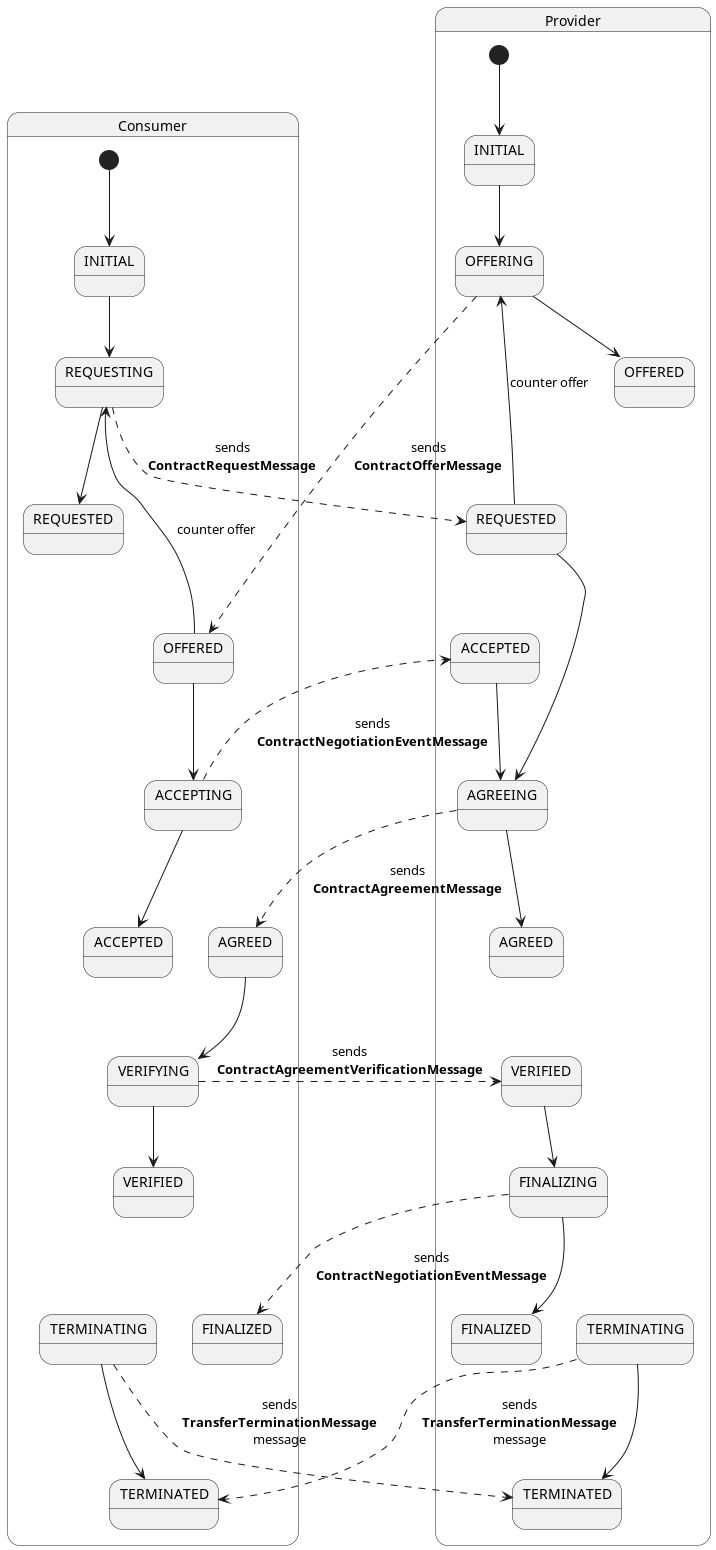
EDC provides a documentation which details the mapping between existing EDC states, the corresponding new EDC states, and the IDS specification states, please refer to here.
The test runs a successful negotiation flow: for the consumer: initiated → requested → agreed → verified → finalized, for the provider: requested → agreed → verified → finalized.
- This is for a successful negotiation; if not it will go from the current state to “terminated”
- Other defined states(e.g. “offered” etc), these are currently not used, but they could be useful if there are other options than just accepting the provider contract as is (currently not implemented in EDC).
- Policies are evaluated during the “requested” phase on the provider.
- During ContractNegotiation, the negotiation has a different id on both provider and consumer
Logs for ContractNegotiation a1a32534-6c1d-4875-bd48-3b2cc41da8eb on the consumer connector as follows:
DEBUG 2024-07-24T12:35:55.205642506 [ConsumerContractNegotiationManagerImpl] ContractNegotiation a1a32534-6c1d-4875-bd48-3b2cc41da8eb is now in state INITIAL
DEBUG 2024-07-24T12:35:55.470100382 [ConsumerContractNegotiationManagerImpl] ContractNegotiation a1a32534-6c1d-4875-bd48-3b2cc41da8eb is now in state REQUESTING
DEBUG 2024-07-24T12:35:55.470552694 ContractNegotiation: ID a1a32534-6c1d-4875-bd48-3b2cc41da8eb. [Consumer] send request
DEBUG 2024-07-24T12:35:55.816844368 ContractNegotiation: ID a1a32534-6c1d-4875-bd48-3b2cc41da8eb. [Consumer] send request
DEBUG 2024-07-24T12:35:55.816948427 [ConsumerContractNegotiationManagerImpl] ContractNegotiation a1a32534-6c1d-4875-bd48-3b2cc41da8eb is now in state REQUESTED
DEBUG 2024-07-24T12:35:56.503153685 DSP: Incoming ContractAgreementMessage for class org.eclipse.edc.connector.controlplane.contract.spi.types.negotiation.ContractNegotiation process: a1a32534-6c1d-4875-bd48-3b2cc41da8eb
DEBUG 2024-07-24T12:35:56.888602662 [CONSUMER] ContractNegotiation a1a32534-6c1d-4875-bd48-3b2cc41da8eb is now in state AGREED.
DEBUG 2024-07-24T12:35:57.549414156 [ConsumerContractNegotiationManagerImpl] ContractNegotiation a1a32534-6c1d-4875-bd48-3b2cc41da8eb is now in state VERIFYING
DEBUG 2024-07-24T12:35:57.549611466 ContractNegotiation: ID a1a32534-6c1d-4875-bd48-3b2cc41da8eb. [consumer] send verification
DEBUG 2024-07-24T12:35:57.838410104 ContractNegotiation: ID a1a32534-6c1d-4875-bd48-3b2cc41da8eb. [consumer] send verification
DEBUG 2024-07-24T12:35:57.838515447 [ConsumerContractNegotiationManagerImpl] ContractNegotiation a1a32534-6c1d-4875-bd48-3b2cc41da8eb is now in state VERIFIED
DEBUG 2024-07-24T12:35:58.533433993 DSP: Incoming ContractNegotiationEventMessage for class org.eclipse.edc.connector.controlplane.contract.spi.types.negotiation.ContractNegotiation process: a1a32534-6c1d-4875-bd48-3b2cc41da8eb
DEBUG 2024-07-24T12:35:58.72499179 [CONSUMER] ContractNegotiation a1a32534-6c1d-4875-bd48-3b2cc41da8eb is now in state FINALIZED.
The corresponding ContractNegotiation c4dec03e-e21f-4103-b186-6a0e8447d1fb logs in the provider connector are as follows:
DEBUG 2024-07-24T12:35:55.588913773 DSP: Incoming ContractRequestMessage for class org.eclipse.edc.connector.controlplane.contract.spi.types.negotiation.ContractNegotiation process
DEBUG 2024-07-24T12:35:55.75999992 [PROVIDER] ContractNegotiation c4dec03e-e21f-4103-b186-6a0e8447d1fb is now in state REQUESTED.
DEBUG 2024-07-24T12:35:56.30306143 [ProviderContractNegotiationManagerImpl] ContractNegotiation c4dec03e-e21f-4103-b186-6a0e8447d1fb is now in state AGREEING
DEBUG 2024-07-24T12:35:56.303415276 ContractNegotiation: ID c4dec03e-e21f-4103-b186-6a0e8447d1fb. [Provider] send agreement
DEBUG 2024-07-24T12:35:56.890075427 ContractNegotiation: ID c4dec03e-e21f-4103-b186-6a0e8447d1fb. [Provider] send agreement
DEBUG 2024-07-24T12:35:56.890262842 [ProviderContractNegotiationManagerImpl] ContractNegotiation c4dec03e-e21f-4103-b186-6a0e8447d1fb is now in state AGREED
DEBUG 2024-07-24T12:35:57.622123397 DSP: Incoming ContractAgreementVerificationMessage for class org.eclipse.edc.connector.controlplane.contract.spi.types.negotiation.ContractNegotiation process: c4dec03e-e21f-4103-b186-6a0e8447d1fb
DEBUG 2024-07-24T12:35:57.837314656 [PROVIDER] ContractNegotiation c4dec03e-e21f-4103-b186-6a0e8447d1fb is now in state VERIFIED.
DEBUG 2024-07-24T12:35:58.44331619 [ProviderContractNegotiationManagerImpl] ContractNegotiation c4dec03e-e21f-4103-b186-6a0e8447d1fb is now in state FINALIZING
DEBUG 2024-07-24T12:35:58.443776224 ContractNegotiation: ID c4dec03e-e21f-4103-b186-6a0e8447d1fb. [Provider] send finalization
DEBUG 2024-07-24T12:35:58.726042394 ContractNegotiation: ID c4dec03e-e21f-4103-b186-6a0e8447d1fb. [Provider] send finalization
DEBUG 2024-07-24T12:35:58.726205646 [ProviderContractNegotiationManagerImpl] ContractNegotiation c4dec03e-e21f-4103-b186-6a0e8447d1fb is now in state FINALIZED
Extensibility of EDC implementations
As we can see, EDC supports several states of a contract negotiation, there are still some states not covered, which could be required. e.g. a PENDING state. To extend the state flow, few options are available as follows:
- Use State Transition Functions: State transition functions (StateTransitionFunction) can be registered at specific callback points which are responsible for transitioning the Contract Negotiation State Machine (CNSM) to a new state. These functions can be used to implement custom workflows. In runtime configurations that support it, transition functions will be called transactionally as part of the ContractNegotiationManager process loop. This will ensure state transitions are atomic. Scanning through the code taught it’s not yet implemented though commit 1ce468.
- Use Event Subscriber: Depending on how the EventSubscriber is registered to the EventRouter (synchronous or asynchronous), in synchronous mode, the subscriber will block the main thread until the event is dispatched, allowing a 'PENDING' state to be added to the flow. To recover the flow, State Machine Specific Manager, specifically the
AbstractContractNegotiationManager, runs in a loop and picks up the entity in a certain state, moving it to the next state when the PENDING tag is reset to false. The managers specific to the contract negotiation state areProviderContractNegotiationManagerImplandConsumerContractNegotiationManagerImpl, both of which implementAbstractContractNegotiationManager.
Measured results
EDC has implemented a state machine and offers an extensible ecosystem; however, these features are not fully available out of the box and may require additional configuration and development. Therefore, based on the criteria outlined in the Comparative criteria (checklists, ...) section of the test description, the test is assigned the following score:
Functional suitability quality metric: 4
Notes
EDC is a pluggable ecosystem primarily targeting Java/Kotlin developers. Some extensions are available on the market for plug-and-play, but for certain specific use cases, developers need to write their own extensions.